leetcode hot 100 题解

leetcode hot 100 题解

1. 深度搜索(recursive 解法)

78. 子集

给你一个整数数组 nums ,数组中的元素 互不相同 。返回该数组所有可能的子集(幂集)。

解集 不能 包含重复的子集。你可以按 任意顺序 返回解集。

示例 1:

1
2
输入:nums = [1,2,3]
输出:[[],[1],[2],[1,2],[3],[1,3],[2,3],[1,2,3]]

示例 2:

<
1
2
输入:nums = [0]
输出:[[],[0]]

提示:

  • 1 <= nums.length <= 10
  • -10 <= nums[i] <= 10
  • nums 中的所有元素 互不相同

题解:

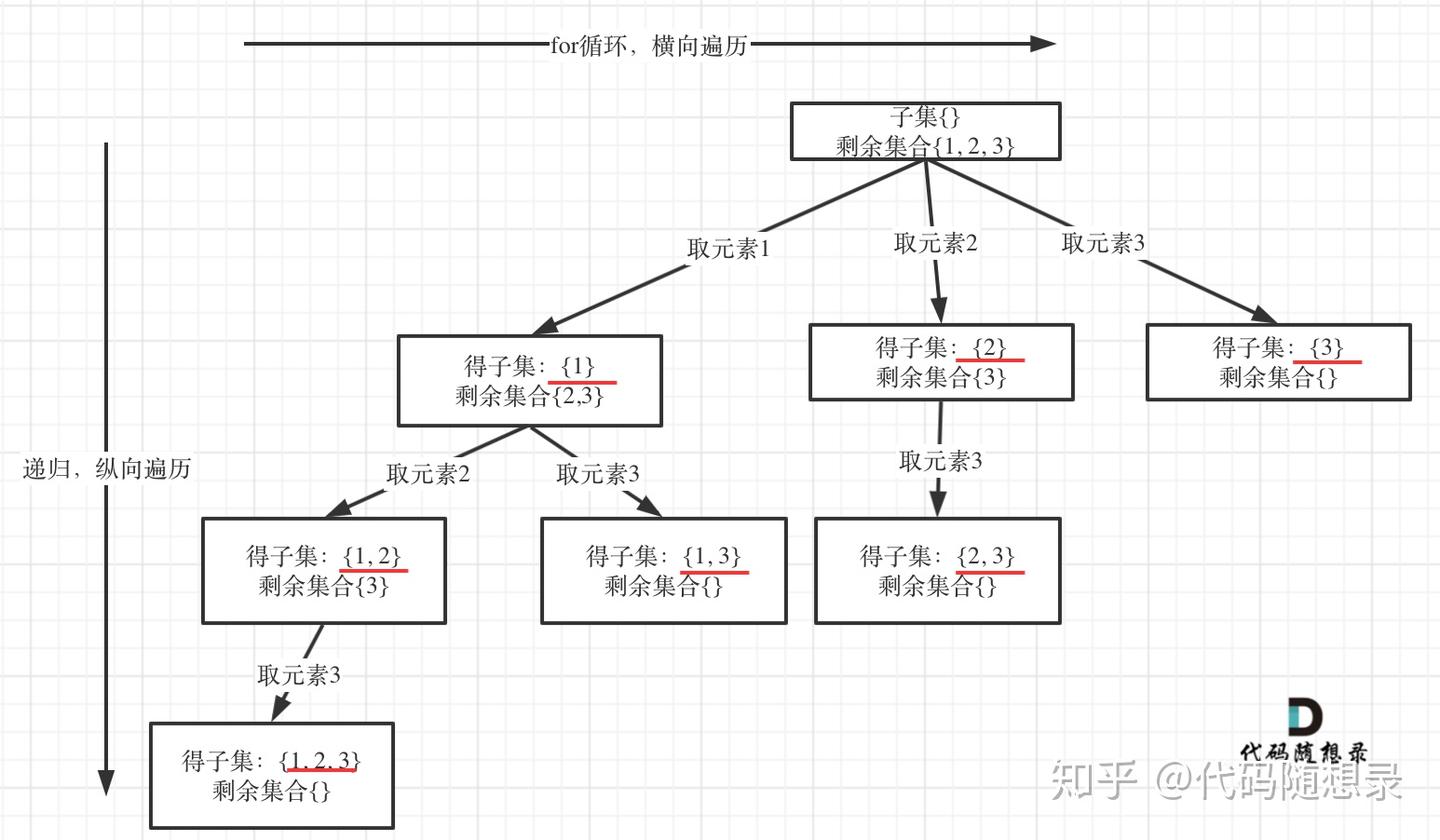
img

调用:dfs(0, [])

  • 得子集:{}
  • 剩余集合:{1,2,3}
  1. 第一层 for 循环
  • i=0 → 取元素 1 → path=[1],进入 dfs(1,[1])
    • 得子集:{1}
    • 剩余集合:{2,3}
  • i=1 → 取元素 2 → path=[2],进入 dfs(2,[2])
    • 得子集:{2}
    • 剩余集合:{3}
  • i=2 → 取元素 3 → path=[3],进入 dfs(3,[3])
    • 得子集:{3}
    • 剩余集合:{}

深入第一条分支(i=0,选了 1)

  • dfs(1, [1]) 里:
    • for 循环 i=1:取 2 → path=[1,2]dfs(2,[1,2])
      • 得子集:{1,2}
      • 剩余集合:{3}
      • 再往下,取 3 → path=[1,2,3]dfs(3,[1,2,3])
        • 得子集:{1,2,3}
        • 剩余集合:{} (递归结束)
      • 回溯 pop 掉 3 → 回到 {1,2}
    • for 循环 i=2:取 3 → path=[1,3]dfs(3,[1,3])
      • 得子集:{1,3}
      • 剩余集合:{}

下面是回朔具体流程:

1
2
3
4
5
6
7
8
9
10
11
12
13
14
15
16
17
18
19
20
21
22
23
24
25
26
27
28
29
30
31
32
33
34
35
36
37
38
39
40
41
42
43
44
45
46
47
48
49
50
51
52
53
54
55
56
57
58
59
60
61
62
63
64
65
66
67
68
69
70
71
72
73
74
75
76
77
78
79
80
81
82
83
84
85
86
87
88
89
90
91
92
93
ENTER dfs(start=0, path=[]) | remaining=[1, 2, 3]

snapshot added -> res=[[]]

choose nums[0]=1

after append -> path=[1]

ENTER dfs(start=1, path=[1]) | remaining=[2, 3]

snapshot added -> res=[[], [1]]

choose nums[1]=2

after append -> path=[1, 2]

ENTER dfs(start=2, path=[1, 2]) | remaining=[3]

snapshot added -> res=[[], [1], [1, 2]]

choose nums[2]=3

after append -> path=[1, 2, 3]

ENTER dfs(start=3, path=[1, 2, 3]) | remaining=[]

snapshot added -> res=[[], [1], [1, 2], [1, 2, 3]]

EXIT dfs(start=3)

backtrack pop 3 -> path=[1, 2]

EXIT dfs(start=2)

backtrack pop 2 -> path=[1]

choose nums[2]=3

after append -> path=[1, 3]

ENTER dfs(start=3, path=[1, 3]) | remaining=[]

snapshot added -> res=[[], [1], [1, 2], [1, 2, 3], [1, 3]]

EXIT dfs(start=3)

backtrack pop 3 -> path=[1]

EXIT dfs(start=1)

backtrack pop 1 -> path=[]

choose nums[1]=2

after append -> path=[2]

ENTER dfs(start=2, path=[2]) | remaining=[3]

snapshot added -> res=[[], [1], [1, 2], [1, 2, 3], [1, 3], [2]]

choose nums[2]=3

after append -> path=[2, 3]

ENTER dfs(start=3, path=[2, 3]) | remaining=[]

snapshot added -> res=[[], [1], [1, 2], [1, 2, 3], [1, 3], [2], [2, 3]]

EXIT dfs(start=3)

backtrack pop 3 -> path=[2]

EXIT dfs(start=2)

backtrack pop 2 -> path=[]

choose nums[2]=3

after append -> path=[3]

ENTER dfs(start=3, path=[3]) | remaining=[]

snapshot added -> res=[[], [1], [1, 2], [1, 2, 3], [1, 3], [2], [2, 3], [3]]

EXIT dfs(start=3)

backtrack pop 3 -> path=[]

EXIT dfs(start=0)


FINAL res = [[], [1], [1, 2], [1, 2, 3], [1, 3], [2], [2, 3], [3]]

Python 答案

1
2
3
4
5
6
7
8
9
10
11
class Solution:
def subsets(self, nums: List[int]) -> List[List[int]]:
res = []
def dfs(start,path):
res.append(path[:])
for i in range(start,len(nums)):
path.append(nums[i])
dfs(i+1,path)
path.pop()
dfs(0,[])
return res

2. 快速选择

215. 数组中的第K个最大元素

**题目:**给定整数数组 nums 和整数 k,请返回数组中第 k 个最大的元素。

请注意,你需要找的是数组排序后的第 k 个最大的元素,而不是第 k 个不同的元素。

示例 :

输入: [3,2,1,5,6,4] 和 k = 2

输出: 5

先学一下什么是快速排序(Quicksort)

快速排序的思想其实很简单,就 3 步:

  1. 挑一个基准数 (pivot)

    • 随便选一个,比如数组第一个或最后一个。
  2. 分区 (partition)

    • 把比 pivot 小的放一边,比 pivot 大的放另一边。
    • pivot 最后就“放到正确的位置上”。
  3. 递归左右两边

    • 左边继续排,右边继续排。

举个例子:排 [3, 2, 1, 5, 6, 4]

  1. pivot=3
    • 比 3 小的:[2,1]
    • 比 3 大的:[5,6,4]
    • 得到 [2,1] + [3] + [5,6,4]
  2. 排 [2,1] → 得 [1,2]
  3. 排 [5,6,4] → 得 [4,5,6]

拼起来 → [1,2,3,4,5,6]

快速选择 (Quickselect)

问题:如果我们只想要「第 k 大元素」,还需要整个数组都排好吗?

👉 不需要!

快速选择就是:

  1. 用快速排序的分区方法,确定 pivot 的位置。
  2. 看 pivot 的位置和 k 的关系:
    • 如果正好等于 k → 找到了!
    • 如果 k 在左边 → 只递归左边。
    • 如果 k 在右边 → 只递归右边。

这样就比快排快,因为它只递归 一边

🌰 举个例子:找 [3, 2, 1, 5, 6, 4] 里的第 2 大

数组 [3,2,1,5,6,4],k=2(第二大的数是 5)。

  1. pivot=3 → partition → [5,6,4,3,2,1]

    • pivot 的位置是 3(第 4 大)。
    • k=2 在左边,所以只递归 [5,6,4]。
  2. 子数组 [5,6,4],pivot=5 → partition → [6,5,4]

    • pivot 的位置是 1(第 2 大)。
    • ✅ 找到了!结果是 5。

时间复杂度

  • 每次 partition O(n)
  • 但每次只递归一边(大约一半大小)
  • 平均复杂度 O(n)

让我们回到这个题 , 根据上面讲的内容,我们需要完成两个函数 , partition 和 select

1
2
3
4
5
6
7
8
9
10
11
12
13
14
15
16
17
def partition(left, right, pivot_index):
"""对区间 [left, right] 做分区,返回 pivot 的最终位置"""
pivot = nums[pivot_index] # 设置基准数

# 1) 把 pivot 先移到末尾,腾出位置
nums[pivot_index], nums[right] = nums[right], nums[pivot_index]

# 2) store_index 指向“左区间”的尾部;左区间里放的都是 > pivot 的
store_index = left
for i in range(left, right):
if nums[i] > pivot: # 注意这里用 '>',因为我们要“第 k 大”
nums[store_index], nums[i] = nums[i], nums[store_index]
store_index += 1

# 3) 把 pivot 放回“中间”,它左边全都 > pivot,右边全都 <= pivot
nums[store_index], nums[right] = nums[right], nums[store_index]
return store_index # 这个位置就是 pivot 的“从大到小”的最终排名(0-based)

我们在 partition(分区) 时,需要:

  1. 遍历 [left, right-1],把比 pivot 大的数放到前面。
  2. 遍历过程中,pivot 不能“碍事”。
  3. 所以先把 pivot 暂时放到末尾,最后再把它放回正确位置。

store_index 指针指向最左边 left ,然后从左往右遍历把比 pivot大的

1
2
3
4
5
6
7
8
9
10
11
12
13
14
15
16
17
18
def select(left, right, idx):
"""在 [left, right] 内找到“从大到小第 idx (0-based) 的元素”"""
while True:
if left == right:
return nums[left]

# 随机化 pivot,降低退化到 O(n^2) 的概率
pivot_index = random.randint(left, right)
pivot_index = partition(left, right, pivot_index)

if idx == pivot_index:
return nums[pivot_index]
elif idx < pivot_index:
right = pivot_index - 1 # 目标在“更大”的左半边
else:
left = pivot_index + 1 # 目标在“更小”的右半边

return select(0, len(nums) - 1, target)
1
2
3
4
5
6
7
8
9
10
11
12
13
14
15
16
17
18
19
20
21
22
23
24
25
26
27
28
29
30
31
32
33
34
35
36
37
38
39
40
41
42
import random
from typing import List

class Solution:
def findKthLargest(self, nums: List[int], k: int) -> int:
target = k - 1 # 从大到小第k大 -> 0-based

# 三路分区:把区间 [left, right] 按 pivot 值分成三段
# 结束后满足:
# nums[left:lt] > pivot
# nums[lt:gt+1] == pivot
# nums[gt+1:right+1] < pivot
# 返回 (lt, gt) —— 等于 pivot 的闭区间
def partition(left: int, right: int, pivot_index: int):
pivot = nums[pivot_index]
nums[pivot_index], nums[right] = nums[right], nums[pivot_index] # 先把 pivot 挪到末尾,便于操作
lt, i, gt = left, left, right
while i <= gt:
if nums[i] > pivot: # 放入“更大”区
nums[lt], nums[i] = nums[i], nums[lt]
lt += 1
i += 1
elif nums[i] < pivot: # 放入“更小”区
nums[gt], nums[i] = nums[i], nums[gt]
gt -= 1 # i 不动,检查换过来的元素
else: # 等于 pivot
i += 1
return lt, gt

left, right = 0, len(nums) - 1
while True:
if left == right:
return nums[left]
pivot_index = random.randint(left, right)
lt, gt = partition(left, right, pivot_index)

if target < lt: # 目标在“更大”的左段
right = lt - 1
elif target > gt: # 目标在“更小”的右段
left = gt + 1
else: # 命中等于段
return nums[target]

leetcode hot 100 题解
http://example.com/2025/09/23/leetcode hot 100 题解 /
Author
John Doe
Posted on
September 23, 2025
Licensed under